


Retirement & Fiscal Policy
Social Security is neither a fraud nor a mystery. It is a math problem with a known deadline, a short list of workable levers, and a narrowing window in which to pull them.
Jessica Marschall, CPA · Marschall Accounting Services, LLC · July 2026
In our tax practice, the question of the solvency of the United States Social Security Program is discussed and debated among clients, our tax team, financial advisors and everyone in between. In studying this program over my career, I attempt to delineate between fact and fiction, hard calculations vs predictions, and especially try to remove bipartisan political lenses from the equation. What follows is, I hope, the reporting of the facts on the ground as well as the opinions of experts, along with my own two-cents.
For the first time in a generation, the date on which Social Security can no longer pay full benefits falls within the working lives of the people it will affect, our tax clients, with those in the Millennials and Gen Z facing automatic benefit cuts. The 2026 report of the Social Security and Medicare Trustees projects that the Old-Age and Survivors Insurance trust fund, the account from which retirement checks are drawn, will run dry in the fourth quarter of 2032. On the day that happens, incoming payroll taxes will still cover roughly 78 percent of scheduled benefits, which means an automatic reduction of about 22 percent for every retiree, survivor, and dependent on the rolls, regardless of age, income, or need. The senators currently serving and those elected over the next several election cycles will be responsible for addressing that deadline.
That prospect has produced a great deal of alarm and a surprising amount of confusion. Social Security is often described as impossibly complicated, or as a program quietly looted by politicians and drained by immigrants. Neither description survives contact with the numbers and facts. What follows is an effort to separate the arithmetic from the mythology, and to set out plainly the options that a serious repair will draw upon.
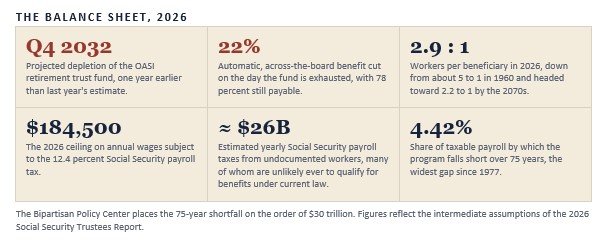
The Bipartisan Policy Center places the 75-year shortfall on the order of $30 trillion. Figures reflect the intermediate assumptions of the 2026 Social Security Trustees Report.
How it works
A ledger, not a vault
To understand the shortfall, it helps to understand what the trust fund actually is, because much of the public debate assumes it is something it never was or intended to be. When Congress created Social Security in 1935, the design contemplated a funded program in which a worker’s contributions would accumulate and roughly match the benefits that worker later received. The 1939 amendments changed that character almost at once. By tying benefits to average earnings and adding spousal and survivor protections that were not separately funded, Congress converted Social Security into a pay-as-you-go system, one in which the payroll taxes of today’s workers pay the benefits of today’s retirees. That is how the program has operated ever since.
The trust fund, in this arrangement, is best understood as a ledger rather than a savings account. When the program ran large surpluses during the peak earning years of the Baby Boom, those surpluses were lent to the Treasury and spent on other government obligations, in exchange for interest-bearing bonds. Those bonds are a genuine asset to the Social Security Administration and an equally genuine liability to the Treasury, which is to say to the taxpayer. The trust fund is the accounting record that tracks the surpluses of the past against the deficits of the present. When that record reaches zero, the law does not permit the program to borrow to cover the gap. It simply pays out what the payroll tax brings in, and no more.

This is the mechanism behind the 2032 cliff. Repaying the bonds does not conjure new money, because the Treasury is both the issuer of those bonds and the party obligated to redeem them. The bonds will be honored. The cliff exists for a simpler reason: the program has promised more than the payroll tax, at its current rate and current ceiling, will collect.
The real cause
Why the gap keeps widening
The causes of the shortfall are demographic, and they are not mysterious. Americans are living longer, so benefits are paid out over more years. The Baby Boom generation is large, and it did not have enough children to replace itself, so the number of workers supporting each beneficiary keeps falling. In 1960, roughly five workers paid into the system for every person drawing benefits. Today the ratio is about 2.9 to 1, and the Trustees project it will decline to roughly 2.2 to 1 by the 2070s. By formula, each successive generation of retirees also receives a somewhat more generous inflation-adjusted benefit than the one before it.
The 2026 report moved the depletion date forward and widened the long-term gap, for reasons worth noting because they cut against the popular narrative. The Trustees lowered their assumed long-run fertility rate from 1.9 to 1.75 children per woman, and they lowered their assumptions about future immigration, both of which shrink the future workforce. The 2025 tax and spending law, by reducing the revenue that flows into the trust funds from the taxation of benefits, worsened the picture as well. Measured over the full 75-year horizon, the shortfall now stands at about 4.42 percent of taxable payroll, the largest imbalance since 1977, which the Bipartisan Policy Center puts on the order of $30 trillion.
Clearing the air
Two myths worth retiring
Around this arithmetic, two competing myths have hardened, one on each side of the political aisle, and both stand in the way of a solution.
The first is the belief that the entire problem disappears if Congress simply lifts the cap on wages subject to the payroll tax, which stands at $184,500 in 2026. The instinct is understandable, because eliminating or substantially increasing the cap is among the most powerful individual policy options available. Depending on how Congress structures the change, particularly whether the additional taxed earnings also generate additional future benefits, it could close a significant portion of the long-term financing gap and materially extend the life of the trust fund. By itself, however, most actuarial analyses conclude that it would not fully resolve the program’s long-term imbalance. Lifting the cap also raises a genuine question about the program’s character, since severing the link between what a worker pays and what a worker collects moves a social-insurance system toward a straightforward transfer program. That may be a defensible choice, but it is a choice nonetheless and needs to be presented as such to voters and taxpayers.
The second myth is the mirror image of the first: that the trust fund was stolen, that immigrants are draining the system, and that deportations and the recovery of raided funds would restore solvency by themselves. The trust fund, as noted, was never a vault to be raided. And the claim about immigration runs precisely backward. Immigrants, including those without legal status, are net contributors to Social Security rather than a drain on it. Widely cited estimates, including analyses from the Institute on Taxation and Economic Policy, suggest that undocumented workers contribute roughly $25 billion to $26 billion each year in Social Security payroll taxes, even though many are unlikely ever to qualify for retirement benefits under current law. The Social Security actuaries concluded years ago that this population produced a net positive effect on the trust fund, and the Congressional Budget Office has projected that the recent rise in immigration would add hundreds of billions of dollars to the program’s revenues over the coming decade while generating only about a billion dollars in eventual claims. Far from hastening insolvency, immigration slows it. The Trustees’ decision to assume less of it is one reason the 2032 date arrived a year early.
A related point deserves candor rather than mythology. Social Security pays benefits across the income spectrum, including many retirees with substantial financial resources, and whether benefits for higher-income households should be modified remains an active policy debate. Defenders of the current structure point out that the benefit formula is already steeply progressive, returning a far larger share of prior earnings to low-wage workers than to high-wage workers, and that means-testing risks converting an earned benefit into welfare while eroding the near-universal support the program depends upon. Both positions are held in good faith, and a durable fix will have to reckon with the tension between them.
The options
The menu of real repairs
Stripped of mythology, closing the gap comes down to three broad levers: collect more revenue, raise the age of eligibility, and adjust the benefit formula, most often for higher earners. Every serious plan is some negotiated combination of the three, and the design question is how hard to pull each one.
On the revenue side, the options run from raising or eliminating the payroll cap, to closing loopholes that let some business owners route wage-like income around the tax (a nod to my S Corp and real estate investor clients!), to a modest across-the-board increase in the payroll rate, to redirecting more of the tax on benefits back into the program, to the more contested idea of extending the tax to investment and other non-wage income (right back at the S Corp real estate investors!). On the benefit side, the options include gradually raising the full retirement age, computing benefits over more years of earnings, and slowing the growth of benefits for those with the highest lifetime wages. Expanded legal immigration functions as a revenue lever of its own, by enlarging the pool of workers paying in.
A useful illustration of how these pieces fit together is a bipartisan proposal published through the Brookings Institution in early 2026 by Wendell Primus, Tara Watson, and Jack Smalligan. Its governing idea is balance. It restores solvency for 75 years using an even mix of tax increases and benefit changes, introduces no new revenue sources beyond the payroll structure, protects everyone already receiving benefits, and leans against general-fund borrowing. It pairs those changes with improvements for survivors, the disabled, and children, so that the plan’s revenue gains roughly offset its net benefit reductions. The table below shows its principal components and their estimated ten-year budget effects.
A Balance Sheet That Balances
A bipartisan proposal published through Brookings, principal provisions and their estimated effect on federal finances, 2025 to 2035. Positive figures strengthen the trust fund; benefit improvements, shown in red, are deliberate costs the plan absorbs.
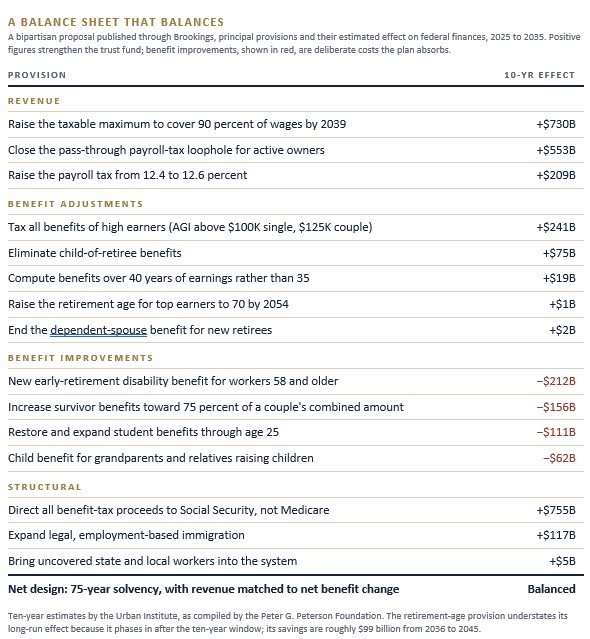
Ten-year estimates by the Urban Institute, as compiled by the Peter G. Peterson Foundation. The retirement-age provision understates its long-run effect because it phases in after the ten-year window; its savings are roughly $99 billion from 2036 to 2045.
Two features of that design are worth underscoring. It raises the retirement age only for higher earners, on the reasoning that longevity has risen sharply for high-income Americans and far less for those at the bottom, for whom a uniform increase would fall hardest. And it treats immigration as part of the solution rather than the problem. Reasonable people will prefer a different mix, whether more revenue and fewer benefit cuts or the reverse, but the proposal shows that a balanced package can reach solvency without exotic measures.
One further idea belongs on the list, if only because Congress has proven so reluctant to revisit the program between crises. An automatic adjustment mechanism would nudge taxes or benefits back toward balance on a set schedule, without requiring a fresh act of political courage each time. As Alicia Munnell of Boston College’s Center for Retirement Research has argued, some version of that safeguard should be on the table once the negotiating begins.
The bottleneck
The harder problem is process
The reason none of this has happened is not that the policy is unknown. It is that raising taxes and cutting benefits are both painful, and the interest groups arrayed on either side punish whoever moves first. The last comprehensive repair, the 1983 amendments, is instructive on both counts. That deal delayed a cost-of-living adjustment (COLA), accelerated a scheduled payroll-tax increase, brought new federal and nonprofit employees into the system, began taxing benefits for higher-income recipients, and raised the full retirement age from 65 to 67, phased in so gradually that the final step did not take effect until 2022. It was brokered by a bipartisan commission, and it worked well enough to buy four decades, even though its architects understood that a growing and aging population would eventually require another round.
That precedent is the model for the most prominent process proposal now before Congress. In June 2026, Representatives Tom Suozzi and Tom Cole introduced the Bipartisan Social Security Commission Act, which would create a thirteen-member, bicameral, bipartisan commission charged with delivering a solvency plan within a year, with any proposal that wins bipartisan majority support receiving expedited consideration on the floors of both chambers. The bill has drawn endorsements across an unusually wide ideological range, from the Bipartisan Policy Center and the Committee for a Responsible Federal Budget to the American Enterprise Institute, Third Way, and the Progressive Policy Institute. It is not the only vehicle in circulation, and analysts disagree about whether the narrower measures also under discussion would accomplish much, but the commission approach has the advantage of a track record.
There is a structural reason bipartisanship is unavoidable here. By law, Social Security cannot be altered through the budget reconciliation process, so any broad change requires sixty votes in the Senate, a threshold neither party is likely to reach alone. Cross-aisle compromise is therefore not a courtesy but a mathematical requirement, which is one more reason the balanced plans are the ones worth studying.
The takeaway
Planning while the terms are set
Like all actuarial projections, the Trustees Reports rest on assumptions about demographics, wages, inflation, productivity, interest rates, and economic growth. The projected depletion date is not a prediction that benefits will necessarily be reduced on that date; it reflects what current law would produce if no legislative changes are enacted. Historically, Congress has modified Social Security financing before projected depletion dates, although there is no assurance that comparable action will occur before the current projection.
For those of us who advise clients on retirement and tax planning, the practical lesson is neither to panic nor to assume the problem away. History suggests that a fix will arrive, because the political cost of allowing an automatic 22 percent cut to fall on more than sixty million beneficiaries is almost certainly greater than the cost of acting. History also suggests that it may arrive late, and that the longer Congress waits, the sharper the eventual adjustments will be. A prudent retirement plan built today should be able to withstand a meaningful reduction in scheduled benefits as a stress test, even while assuming, on balance, that the program endures. Social Security is not going away. It is being renegotiated, on a deadline, and the terms of that renegotiation are worth understanding before they are set.
Jessica Marschall, CPA
Marschall Accounting Services, LLC · marschalltax.com
This article is provided for general educational purposes only and does not constitute tax, legal, actuarial, or investment advice. Projections and figures reflect published estimates as of mid-2026 and are subject to revision as economic conditions and legislation change.
Principal sources
2026 Social Security and Medicare Trustees Reports and the SSA Office of the Chief Actuary · Committee for a Responsible Federal Budget · Bipartisan Policy Center · Center for Retirement Research at Boston College · Brookings Institution (Primus, Watson, and Smalligan) · Peter G. Peterson Foundation · Institute on Taxation and Economic Policy · Congressional Budget Office · Office of Rep. Tom Suozzi (H.R. 9187).